Blog 1
DDoS PROTECTION IN AMAZON GAMELIFT SERVERS
| Published | 03/07/2026 |
| Platform | AWS Study Group |
| Link | https://www.facebook.com/photo?fbid=2182481875876802&set=gm.2202654247166202&idorvanity=660548818043427 |
| Evidence | 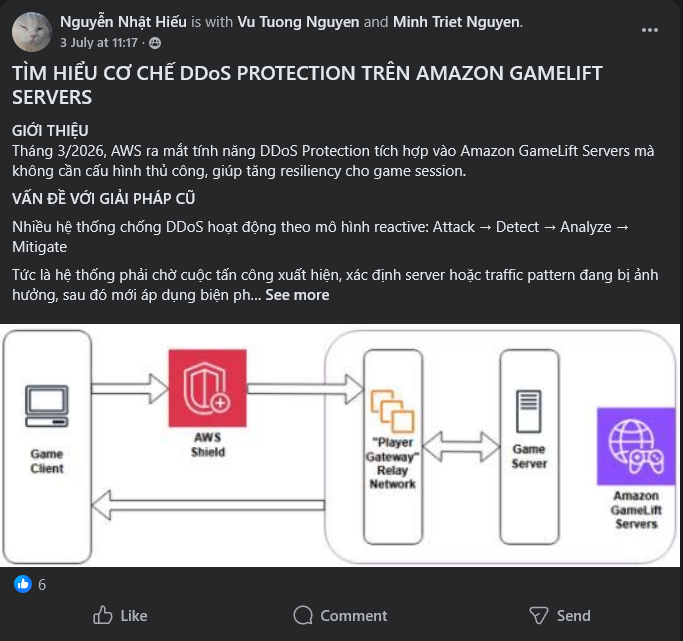 |
INTRODUCTION
In March 2026, AWS introduced integrated DDoS protection for Amazon GameLift Servers, improving the resilience of game sessions against distributed denial-of-service attacks.
Instead of allowing game clients to connect directly to the IP address and port of a game server, the new mechanism routes traffic through Amazon GameLift Servers Player Gateway.
Player Gateway acts as an intermediary layer between players and game servers. It authenticates individual players, limits traffic, distributes connections across multiple relay endpoints, and supports automatic endpoint failover.
The important difference is that this mechanism does not wait until an attack has already affected the server. It proactively reduces the attack surface by hiding the game server from clients and filtering invalid traffic before it reaches the game session.
THE PROBLEM WITH TRADITIONAL SOLUTIONS
Many traditional DDoS protection systems use a reactive model:
Attack → Detect → Analyze → Mitigate
The system must wait for an attack to appear, identify the affected server or traffic pattern, and then apply a mitigation rule.
For online games, this delay can be significant. Even a few seconds of packet loss, jitter, or increased latency can interrupt a game session and negatively affect the player experience.
This problem is especially relevant to UDP traffic, which is commonly used by real-time games such as:
- first-person shooters;
- MOBAs;
- racing games;
- action games;
- low-latency multiplayer games.
UDP does not establish a connection in the same way as TCP. An attacker can therefore generate large volumes of spoofed or invalid packets and send them directly to the IP address and port of a game server.
Traditional protection mechanisms often rely on byte-matching rules or traffic signatures to identify malicious packets.
This approach has two major limitations:
- The system must already know the characteristics of the malicious packet.
- Rules must be continuously updated when attackers change their attack patterns.
As a result, the defense is often at least one step behind the attacker.
THE AWS SOLUTION: PLAYER GATEWAY
The central component of the new DDoS protection mechanism is Amazon GameLift Servers Player Gateway.
Player Gateway provides a relay networking layer between the game client and the game server.
The general connection flow is:
Game client
    ↓
Player Gateway relay endpoint
    ↓
Amazon GameLift game server
The client does not need to know the real IP address of the game server. It only receives the token and relay endpoints required to join the game session.
Player Gateway consists of three primary mechanisms:
- Relay Networking with Token Authentication.
- Multi-Relay.
- Dynamic Failover.
1. RELAY NETWORKING AND TOKEN AUTHENTICATION
In a traditional connection model, the game client connects directly to the IP address and port of the game server.
This exposes the game server address to the client. If an attacker obtains that information, they can send a large volume of UDP traffic directly to the server.
With Player Gateway, the client no longer connects directly to the game server.
When a player is about to join a game session, the game backend calls:
GetPlayerConnectionDetails
The API returns:
- a Player Gateway Token;
- a list of relay endpoints;
- the connection information required by the game client.
The backend then sends this information to the client.
When sending UDP traffic, the client attaches the Player Gateway Token to the beginning of each packet and sends the packet to a relay endpoint instead of the game server address.
The packet-processing flow can be represented as:
UDP packet
    ↓
Player Gateway Token
    ↓
Relay endpoint
    ↓
Token validation
    ↓
Original game payload
    ↓
Game server
The relay validates the token before allowing traffic to continue.
- Packets without a token are dropped.
- Packets with an invalid token are dropped.
- Packets with a valid token are forwarded to the game server.
Before forwarding the packet, Player Gateway removes the token and sends only the original payload to the server. The game server therefore continues to receive packets in the expected format.
Response traffic from the game server to the client also travels through the relay network.
This provides two major benefits.
First, the real IP address of the game server is hidden from the player. The client only receives relay endpoint addresses.
Second, unauthenticated traffic can be discarded before it reaches the game server.
PER-PLAYER TRAFFIC LIMITING
In addition to token authentication, Player Gateway applies traffic limits to individual players.
This helps protect against an attacker who has a valid token, such as an attacker who joins a game session as a normal player and then sends an abnormal volume of traffic.
Player Gateway can limit that player’s traffic before it reaches the game server.
As a result, a compromised client or malicious player has less opportunity to use a valid connection to overload the entire game session.
2. MULTI-RELAY
Each player receives multiple relay endpoints instead of a single endpoint.
The relay endpoint list can also differ between players in the same game session.
For example:
| Player | Relay endpoints |
|---|---|
| Player A | Relay 1, Relay 2, Relay 3 |
| Player B | Relay 2, Relay 4, Relay 5 |
| Player C | Relay 1, Relay 4, Relay 6 |
This distribution prevents all traffic from being concentrated on one relay.
If every player in a game session used the same relay, that relay could become a single point of failure. An attack against the relay could interrupt the session for every player.
With Multi-Relay, traffic is distributed across the relay infrastructure.
If one endpoint is attacked or becomes unhealthy, the impact can be isolated to a subset of connections instead of affecting the entire game session.
This approach also makes an attack more difficult. An attacker must deal with a dynamically distributed set of endpoints rather than one fixed server address.
3. DYNAMIC FAILOVER
Relay endpoints are not fixed for the entire lifetime of a game session.
When a relay becomes unhealthy, Amazon GameLift Servers can replace the endpoint and return updated information through a subsequent API call.
The client can then move traffic to another endpoint without reconnecting directly to the game server.
AWS provides two endpoint-selection mechanisms:
- Fallback;
- Predictive Rotation.
FALLBACK
In Fallback mode, the client uses one primary relay endpoint.
The client continues sending traffic to that endpoint until it fails or becomes unavailable. It then switches to another endpoint from the list.
Relay A
    ↓ unhealthy
Relay B
    ↓ unhealthy
Relay C
Fallback is suitable for game types or features that are less sensitive to temporary packet loss, including:
- lobbies;
- menus;
- matchmaking screens;
- turn-based games;
- activities that do not require continuous real-time updates.
The limitation is that some packets may be lost while the client detects the failure and switches to another endpoint.
PREDICTIVE ROTATION
Predictive Rotation continuously rotates traffic between relay endpoints.
Instead of waiting for an endpoint to stop working completely, the client and Player Gateway proactively use multiple endpoints and anticipate failures before an endpoint becomes unavailable.
This approach reduces the interruption window during failover and provides more stable packet delivery.
Predictive Rotation is more suitable for real-time games such as:
- first-person shooters;
- racing games;
- action multiplayer games;
- battle royale games;
- games that require continuous packet delivery and low latency.
For these game types, even a brief connection interruption can cause player movement errors, missed input, or state synchronization problems.
FROM REACTIVE TO PROACTIVE DEFENSE
The main difference between traditional mitigation and Player Gateway is when traffic is processed.
In a traditional model:
Traffic reaches server
    ↓
Attack is detected
    ↓
Traffic is analyzed
    ↓
Mitigation is applied
With Player Gateway:
Traffic reaches relay
    ↓
Token is validated
    ↓
Player traffic is limited
    ↓
Only valid traffic reaches the game server
Invalid traffic is removed at the relay layer before it reaches the game server.
The game server IP address is also not provided directly to players, reducing the ability of an attacker to target the server hosting the game session.
Multi-Relay and Dynamic Failover further reduce the impact by distributing traffic and moving connections away from unhealthy relays.
GENERAL OPERATION FLOW
The complete process can be summarized as follows:
- A player requests to join a game session.
- The game backend calls
GetPlayerConnectionDetails. - Amazon GameLift Servers returns a Player Gateway Token and relay endpoints.
- The backend sends the connection information to the game client.
- The client attaches the token to each UDP packet.
- The client sends packets to a relay endpoint.
- The relay validates the token.
- The relay limits traffic for the individual player.
- The relay removes the token and forwards the payload to the game server.
- Responses from the game server travel back through the relay.
- If a relay becomes unhealthy, the client switches to another endpoint.
Player
   ↓ Request connection
Game backend
   ↓ GetPlayerConnectionDetails
Amazon GameLift Servers
   ↓ Token + relay endpoints
Game client
   ↓ Authenticated UDP packets
Player Gateway
   ↓ Validated game traffic
Game server
IMPLEMENTATION CONSIDERATIONS
Amazon GameLift Servers DDoS protection is managed by AWS, but this does not mean that game developers have no integration work.
To use Player Gateway, a game system still needs to:
- enable Player Gateway for the relevant GameLift resources;
- update the game backend to call
GetPlayerConnectionDetails; - send tokens and relay endpoints to the client;
- update the game client to attach tokens to UDP packets;
- implement relay endpoint selection;
- implement Fallback or Predictive Rotation based on game requirements;
- refresh endpoint information when relay assignments change.
AWS operates the relay infrastructure and the underlying protection mechanisms. However, the backend and client must follow the Player Gateway connection flow.
CONCLUSION
Amazon GameLift Servers DDoS Protection changes how game servers are protected against UDP-based DDoS attacks.
Instead of allowing traffic to reach the server before detecting and mitigating an attack, Player Gateway proactively routes traffic through a relay network.
At the relay layer, the system:
- validates Player Gateway Tokens;
- drops invalid packets;
- limits traffic per player;
- hides the real game server IP address;
- distributes connections across multiple relays;
- automatically moves traffic when a relay becomes unhealthy.
This reduces the risk of direct attacks against the game server and helps game sessions maintain connectivity when part of the relay infrastructure experiences an attack or failure.
The mechanism is especially useful for UDP-based multiplayer games with low-latency requirements, where even a short disruption can directly affect the player experience.